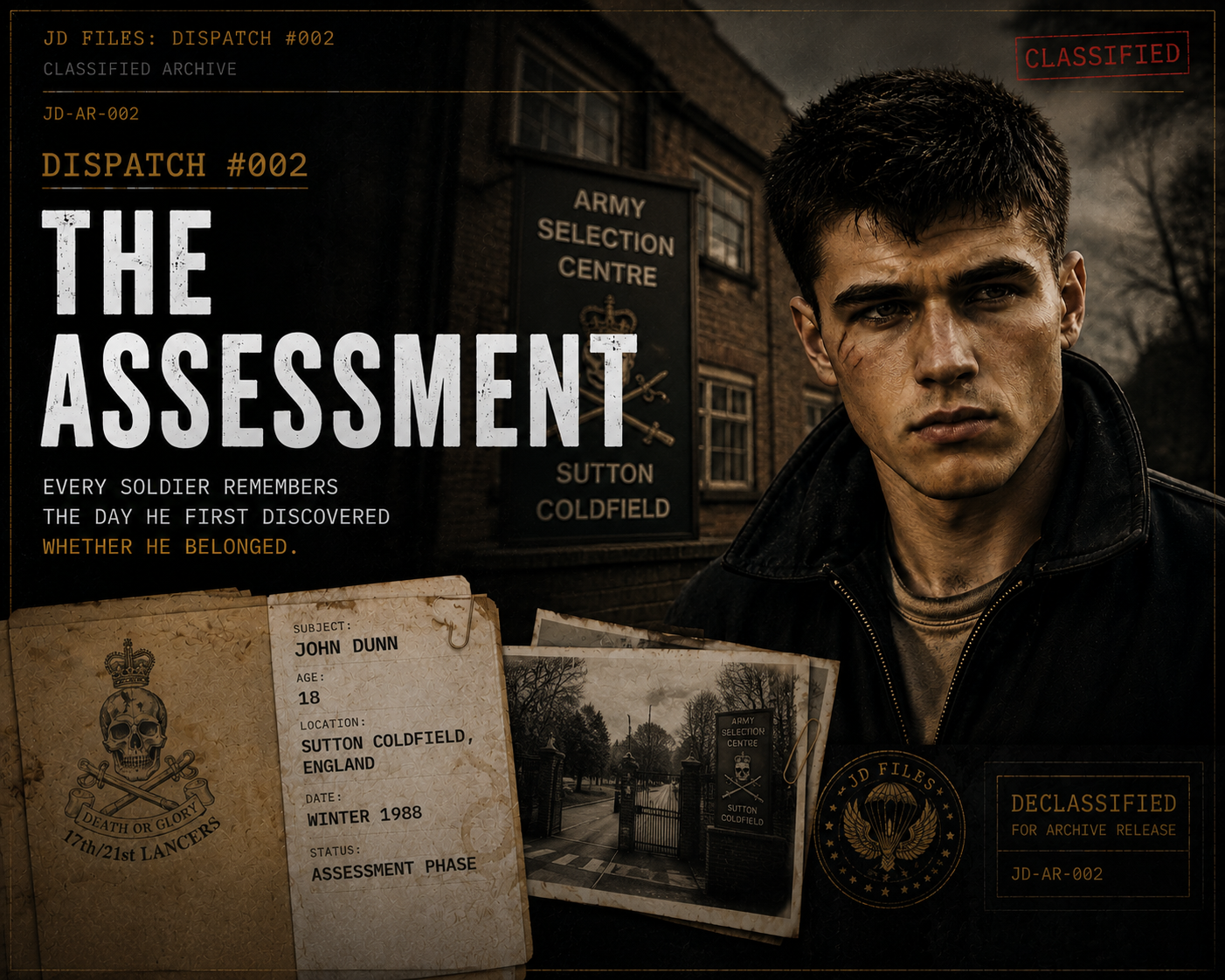
JD FILES DISPATCH #002
THE ASSESSMENT
STATUS: Declassified
SUBJECT: John Dunn
FILE CLASSIFICATION: Archive Report
REFERENCE: JD-AR-002
DATE: Winter 1988
LOCATION: Sutton Coldfield Selection Centre, England
Intelligence Summary
Every soldier remembers the day he first discovered whether he belonged.
For John Dunn, that day arrived on a cold winter morning at the Army Selection Centre in Sutton Coldfield.
The recruiting interviews were over.
The paperwork had been completed.
Now came the first genuine test.
The Army would decide whether he had what it took.
The coach arrived before dawn.
Dozens of young men climbed aboard from collection points across the Midlands. Most carried cheap holdalls. Some wore trainers that looked as though they had never been used for running. Others sat quietly staring through rain-streaked windows, lost in their own thoughts.
Nobody spoke much.
Every man knew why he was there.
By mid-morning the coach rolled through the gates of the Army Selection Centre.
The place looked exactly how John imagined an Army establishment should look.
Functional.
Orderly.
Unimpressed by excuses.
The candidates were ushered into briefing rooms and divided into groups.
The staff wasted no time.
Forms were checked.
Instructions were given.
The process began immediately.
The aptitude testing came first.
John recognised some of the questions from the earlier recruiting office assessment, but these were noticeably harder.
Pattern recognition.
Mechanical reasoning.
Mental arithmetic.
Problem solving.
Maps.
Distances.
Bearings.
Nothing was individually difficult, yet the sheer volume of questions created pressure.
Several candidates became visibly flustered.
One young man abandoned a section entirely.
Another repeatedly checked his watch.
John ignored them all.
Years later he would struggle to remember specific questions.
What he remembered instead was a simple lesson:
The Army rarely cared how clever you thought you were.
It cared how well you performed when time mattered.
The medical assessments followed.
Eyesight.
Hearing.
Mobility.
Weight.
Measurements.
Doctors moved candidates from room to room with assembly-line efficiency.
No drama.
No encouragement.
You either met the standard or you did not.
For some candidates the process ended there.
Quiet conversations occurred behind closed doors.
A few names disappeared from the roster.
Nobody asked questions.
Nobody needed to.
The Army had made its decision.
The fitness tests came next.
This was the part John had anticipated.
He had always enjoyed physical activity.
Running.
Football.
Cycling.
Anything that involved competition.
Yet standing among dozens of strangers waiting to be assessed created an unfamiliar feeling.
Expectation.
The instructors explained the requirements.
The standards were clear.
Pass.
Or fail.
Simple.
The whistle sounded.
The first candidates set off.
One by one the assessments continued throughout the day.
John discovered something important.
He was fitter than most.
Not dramatically.
Not exceptionally.
But enough to notice.
Several candidates struggled.
Others completed the tests but only just.
John finished with energy remaining.
The instructors said little.
They merely wrote notes on clipboards.
But he noticed one of them glance briefly at another and nod.
It was a small moment.
Almost insignificant.
Yet it stayed with him.
That evening the atmosphere changed.
The candidates finally relaxed.
Conversations began.
Stories were exchanged.
Some spoke confidently about joining elite units.
Others admitted they simply wanted a steady career.
A surprising number had no real understanding of military life at all.
John listened more than he spoke.
He found himself studying people.
Assessing them.
Not consciously.
Not yet.
But the habit had already begun forming.
Years later it would become second nature.
A survival skill.
A professional necessity.
The ability to read a room.
To identify confidence.
Fear.
Competence.
Weakness.
The foundations were being laid long before he realised it.
The final interviews took place the following morning.
Candidates were called individually.
Recommendations were discussed.
Potential career paths considered.
Not everyone would be offered the role they requested.
The Army allocated manpower according to ability and requirement.
Technical candidates gravitated towards technical corps.
Natural athletes often found themselves directed elsewhere.
The decision was not always popular.
But it was rarely random.
When John’s turn came, the discussion was brief.
His aptitude scores were solid.
His fitness scores were strong.
His attitude had impressed those assessing him.
The recommendation was clear.
He would be offered a place.
The only question remaining was where.
Among the options presented to him, one immediately captured his imagination.
The 17th/21st Lancers.
A cavalry regiment with a proud history.
And a cap badge unlike any other.
A skull.
Crossed bones.
A simple motto beneath:
Death or Glory.
To some it may have appeared theatrical.
To an eighteen-year-old determined to escape ordinary life, it looked magnificent.
The decision required no deliberation.
John accepted.
The coach journey home felt different.
Nothing tangible had changed.
He was not yet a soldier.
Training had not begun.
No uniform had been issued.
Yet the direction of his life had shifted.
The future suddenly seemed larger.
More dangerous.
More exciting.
Somewhere ahead waited Basic Training.
Beyond that waited regiment life.
And beyond that—although he could not yet know it—waited a path leading towards airborne forces, Special Forces selection and a future buried beneath classified files.
For now, however, none of that mattered.
The only thing that mattered was that he had passed.
The journey had officially begun.
Archive Note
Personnel records indicate that Sutton Coldfield Selection Centre was the first occasion on which John Dunn’s physical and cognitive abilities were formally assessed by the British Army. Assessment notes describe him as motivated, physically capable and possessing above-average military potential. Within twelve months he would begin seeking transfer opportunities beyond his original regiment.
File Closed
JD ARCHIVE REFERENCE: JD-AR-002
READ MORE DISPATCHES