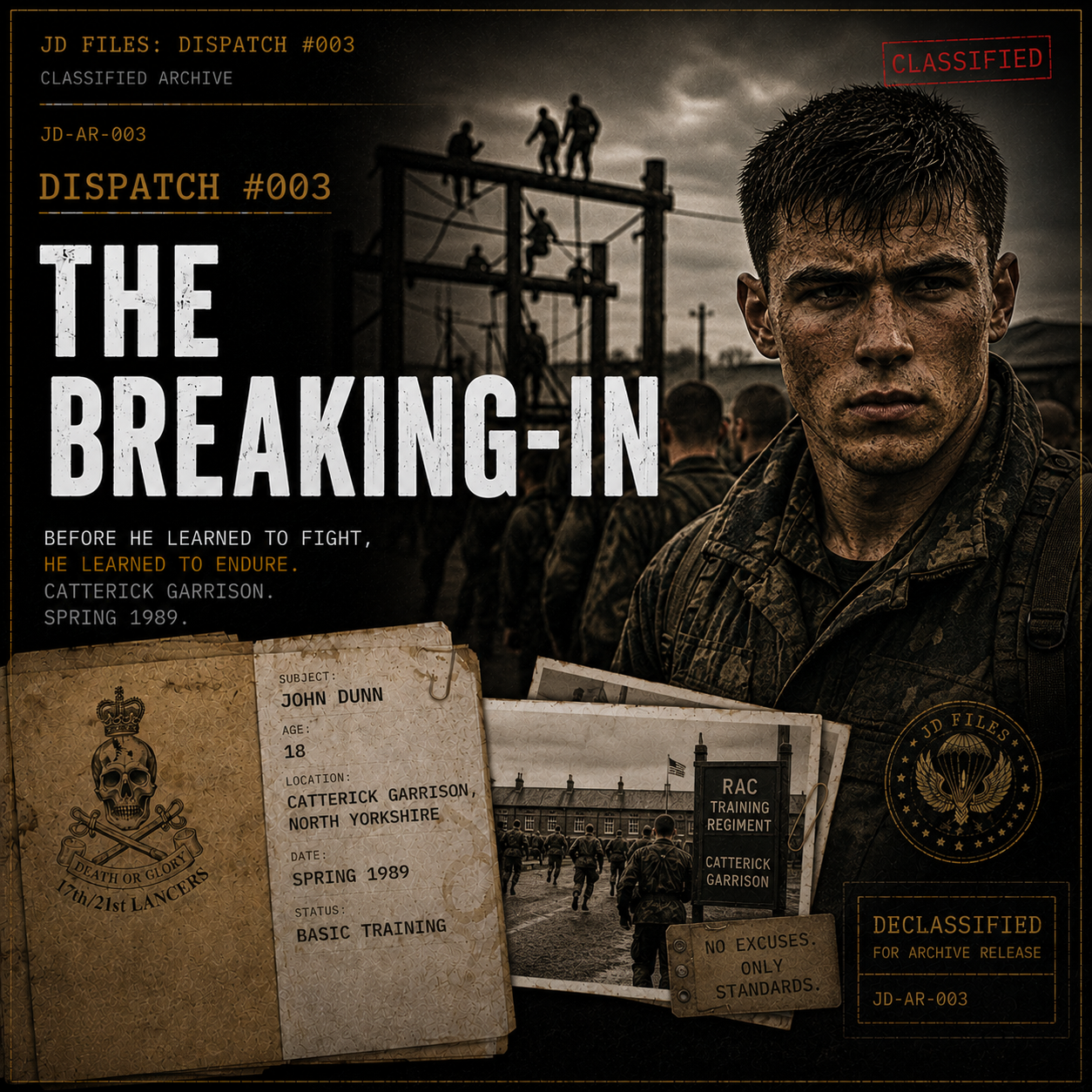
JD FILES DISPATCH #003
THE BREAKING-IN
STATUS: Declassified
SUBJECT: John Dunn
FILE CLASSIFICATION: Archive Report
REFERENCE: JD-AR-003
DATE: Spring 1989
LOCATION: Royal Armoured Corps Training Regiment, Catterick Garrison, North Yorkshire
STATUS: Declassified
Intelligence Summary
Before he learned to fight, he learned to endure.
Before he carried ammunition, he carried exhaustion.
For eighteen-year-old John Dunn, basic training was six weeks of pressure, discipline, sleep deprivation and relentless repetition.
The Army wasn’t trying to teach him how to be comfortable.
It was trying to discover whether he could keep going when comfort disappeared.
The first shock was not the shouting.
It was the speed.
Everything happened faster than expected.
Faster than the recruiting office had described.
Faster than seemed possible.
The coach arrived at Catterick carrying a collection of nervous young men from every corner of Britain. Some talked endlessly to hide their nerves. Others stared silently through the windows.
Nobody knew what awaited them.
The corporals did.
And they seemed determined to waste no time introducing it.
The moment the recruits stepped off the coach, the pressure began.
Orders.
Timings.
Instructions.
More orders.
Everything delivered at a pace designed to overwhelm.
By the end of the first hour, John realised something important.
The Army was not interested in excuses.
Only results.
The days started before dawn.
Sometimes well before dawn.
The recruits would stumble from their beds already tired from the previous day.
The barrack room lights exploded into life.
Voices followed.
The day had begun.
Within minutes everyone was dressing, cleaning, shaving, folding blankets, making beds and preparing for inspection.
The inspections became legendary.
Hours could be spent preparing a bed space to perfection.
Blankets stretched tight.
Lockers arranged precisely.
Boots aligned.
Floors polished.
Then the inspecting corporal would arrive.
He would examine everything.
Occasionally he would nod.
More often he would find fault.
A misplaced item.
Dust behind a locker.
An imperfectly folded garment.
Sometimes an entire display would be dismantled without warning.
The recruits would watch their hard work collapse in seconds.
Then they would start again.
And the next morning they would do it all over again.
The boots became an obsession.
Every evening recruits sat on beds or floors with polish, brushes and cloths.
The goal was simple.
Produce a mirror shine.
A finish so reflective that faces could be seen in the leather.
Some achieved it.
Most struggled.
Hours disappeared beneath layers of polish.
Sometimes recruits worked late into the night.
Only for an inspecting instructor to pick up the boot the following morning and launch it across the room.
The lesson was never about footwear.
The lesson was standards.
And standards mattered.
The change parades were chaos disguised as training.
Entire platoons would stand outside barrack blocks in full uniform.
An instructor would inspect them.
Then shout an order.
Two minutes.
Change into barrack dress.
Move.
The recruits would sprint.
Uniforms flew.
Boots scattered.
Buttons fought back.
Two minutes later they would be formed up again.
Another order.
Another change.
Combat kit.
PT kit.
Barrack dress.
Back again.
The process repeated until everyone was exhausted and confused.
Then came the real surprise.
An eight-mile run.
Breakfast was earned.
Nobody walked into the cookhouse fresh and relaxed.
The recruits arrived sweating, hungry and half exhausted.
The Army quickly taught a simple truth.
Food tasted better when you genuinely needed it.
And after a morning of change parades, inspections and running, everyone needed it.
The training itself was relentless.
Drill on the square.
Weapon handling.
Map reading.
Military history.
First aid.
The role of the British Army.
The values expected of a soldier.
Every hour seemed planned.
Every minute accounted for.
The instructors demanded attention to detail.
A mistake repeated once might be corrected.
A mistake repeated twice became memorable.
Usually for all the wrong reasons.
Then came the fieldcraft.
For many recruits, this was where soldiering finally started to feel real.
Camouflage.
Concealment.
Patrolling.
Observation.
Navigation.
Living outdoors.
The first exercise placed recruits in woods and training areas for several days.
Sleep became a luxury.
Comfort disappeared completely.
The weather ignored complaints.
The instructors ignored them too.
Yet something interesting happened.
The harder the training became, the more John enjoyed it.
While others merely endured, he seemed to thrive.
Fieldcraft made sense to him.
Navigation came naturally.
Physical hardship bothered him less than most.
Instructors noticed.
Though they rarely said so.
The gas chamber was an experience nobody forgot.
Recruits entered wearing respirators.
Inside, they practised drills.
Changing canisters.
Communicating.
Eating.
Drinking.
Working while wearing protective equipment.
Then came the final instruction.
Remove respirators.
Every recruit knew what was coming.
Nobody wanted to be first.
The effects were immediate.
Eyes watered.
Noses streamed.
Lungs protested.
One by one recruits stepped forward before the instructor.
Number.
Rank.
Name.
Spoken clearly.
Eyes open.
Only then were they allowed to leave.
Fresh air had never tasted so good.
Weeks passed.
The platoon changed.
The weakest recruits improved.
Friendships formed.
Nicknames appeared.
Confidence grew.
Civilian habits slowly disappeared.
Soldier habits replaced them.
Without realising it, the recruits were being transformed.
Not into fighting men.
Not yet.
But into something closer.
A foundation was being built.
Among the instructors was one man who stood apart.
A former member of the Parachute Regiment.
He rarely needed to shout.
He didn’t need to.
His standards spoke loudly enough.
The recruits respected him because he had done things they only heard stories about.
One afternoon, after a route march, he stopped Dunn briefly.
Nothing dramatic.
Just a short conversation.
A few questions.
A few observations.
Then one final comment.
“You ever thought about Airborne?”
Dunn hadn’t.
Not seriously.
The instructor nodded.
“You should.”
Then he walked away.
For the remainder of the day, the comment stayed with him.
For the remainder of the week, it stayed with him.
Eventually it became something more.
An idea.
Then an ambition.
Then an obsession.
Basic training ended with a passing-out parade.
Families arrived.
Uniforms were immaculate.
Boots shone.
The recruits stood taller than they had six weeks earlier.
Something had changed.
The Army had achieved exactly what it intended.
The civilians who arrived at Catterick no longer existed.
Soldiers stood in their place.
After leave, continuation training awaited.
The journey into the Royal Armoured Corps would continue.
But for John Dunn, another path had already begun to emerge.
A red beret.
A pair of wings.
And a challenge that refused to leave his mind.
Archive Note
Training reports from Catterick describe John Dunn as physically exceptional within his intake, displaying strong fieldcraft aptitude, rapid skill acquisition and unusually high endurance levels. Several instructors noted leadership potential. One former Parachute Regiment instructor is believed to have significantly influenced Dunn’s decision to pursue Airborne forces shortly after completing basic training.
File Closed
JD ARCHIVE REFERENCE: JD-AR-003
READ MORE DISPATCHES