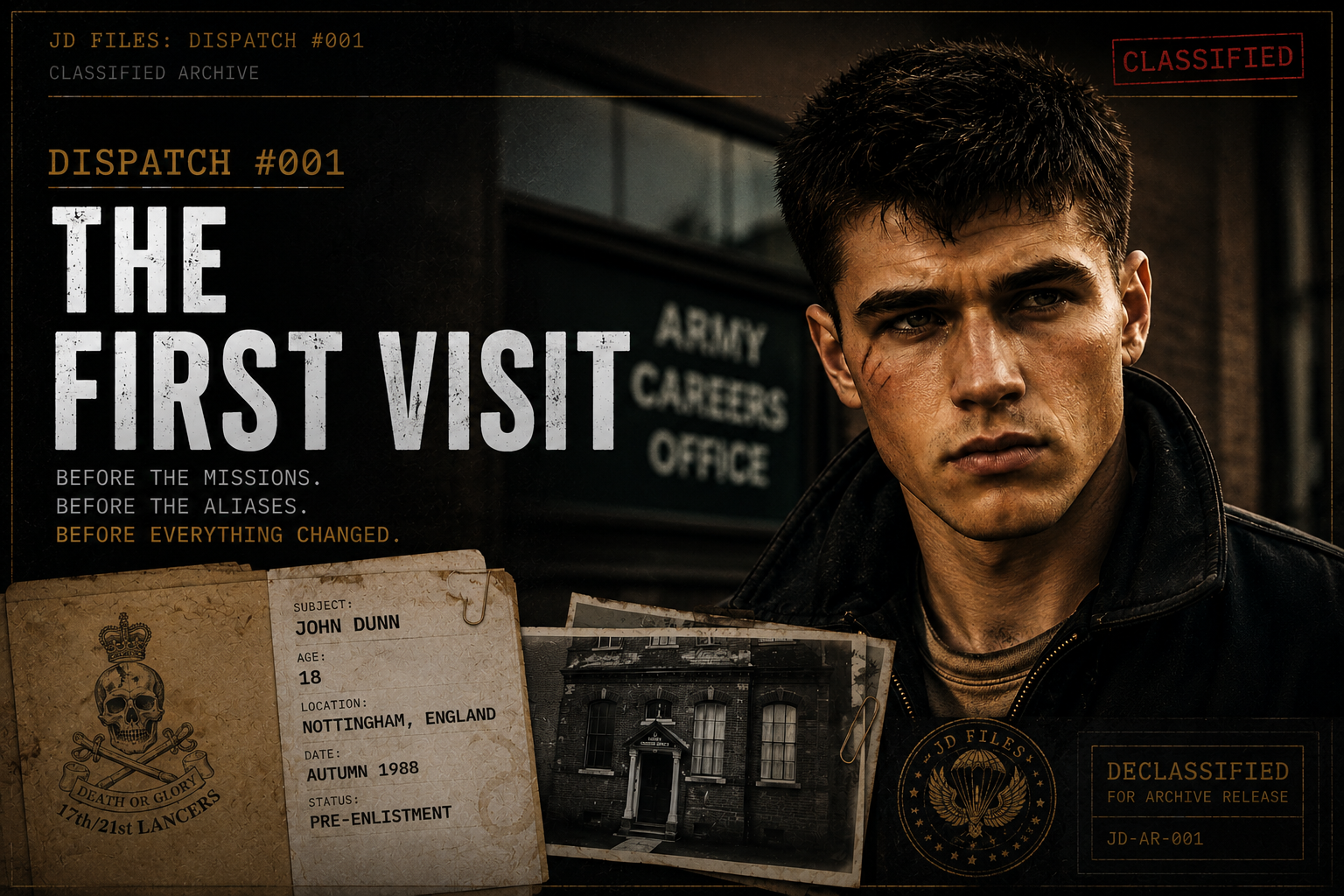
JD FILES DISPATCH #001
THE FIRST VISIT
STATUS: Declassified
SUBJECT: John Dunn
FILE CLASSIFICATION: Archive Report
REFERENCE: JD-AR-001
DATE: Autumn 1988
LOCATION: Nottingham, England
Intelligence Summary
Long before the missions, before the aliases, before the files that would eventually vanish into classified archives, there was a young man standing outside a small Army Careers Office near Nottingham’s Victoria Centre. He had no idea that the decision he was about to make would alter the course of his entire life.
This report details the first documented step in John Dunn’s military journey.
The rain had stopped only minutes earlier.
The pavements of Nottingham city centre still glistened beneath a grey autumn sky as eighteen-year-old John Dunn stood outside the Army Careers Information Office. Commuters moved around him without a second glance. Shop shutters rattled open. Buses growled past in the morning traffic.
For a moment he simply stared at the door.
Until then, the Army had existed only in television programmes, newspaper headlines and recruitment adverts. Soldiers belonged to another world. A world of discipline, challenge and adventure. A world far removed from the ordinary life he had known.
Taking a breath, he stepped inside.
The office smelled faintly of polished floors, paperwork and strong tea.
Behind a desk sat a Staff Sergeant whose years of service were immediately obvious. His uniform was immaculate. His bearing relaxed but professional. He looked up from a file and studied the young man standing before him.
“Can I help you?”
John nodded.
“I’d like to know more about joining the Army.”
The Staff Sergeant gestured towards a chair.
“Take a seat then.”
What followed was not an interview. Not yet.
It was a conversation.
The Staff Sergeant explained what life as a soldier actually looked like beyond the recruiting posters. He spoke about Basic Training, where civilians were transformed into soldiers through discipline, fitness and repetition. He described early mornings, inspections, drill, weapon handling and fieldcraft.
Then he explained continuation training.
Passing Basic Training did not mean a recruit was fully trained. Every regiment and corps had specialist training that followed. Drivers, signallers, infantrymen, tank crewmen, engineers—all required additional instruction before joining operational units.
John listened carefully.
The Staff Sergeant then described life in a regiment.
Barrack room life.
The friendships.
The standards.
The realities of living and working alongside dozens of other young men from every corner of Britain.
Some recruits struggled.
Some thrived.
The Army rewarded effort, reliability and determination.
By the end of the discussion, John realised he was no longer simply curious.
He wanted in.
The Staff Sergeant must have noticed.
Before John left, an appointment was arranged for a formal assessment.
The next stage of the process.
Several weeks later, John returned.
This time the atmosphere felt different.
More serious.
More official.
The assessment consisted of a series of aptitude tests designed to determine where a potential recruit might best fit within the Army.
The papers covered general knowledge, problem solving, mental arithmetic and basic map-reading skills. Nothing was especially difficult, but they required concentration and common sense.
John completed them methodically.
The Staff Sergeant reviewed the results before preparing his recommendation.
Different parts of the Army required different abilities.
Some roles demanded higher technical aptitude.
Others required practical problem solving.
Some favoured leadership potential.
Others required exceptional physical robustness.
The recommendation would eventually be reviewed by the recruiting officer—a Major responsible for approving candidates before they progressed further.
The Major conducted a short interview.
Questions were asked.
Motivation was assessed.
Attitude was observed.
The Army could teach skills.
It could not teach commitment.
When the interview ended, John was informed he would be offered a place on the next selection course at Sutton Coldfield.
The real test was about to begin.
Sutton Coldfield represented a significant step forward.
Candidates from across the country arrived to undergo further aptitude assessments, medical examinations and physical fitness tests.
Many failed.
Some withdrew.
Others discovered that the regiment they wanted was not necessarily the regiment they would be offered.
The Army allocated recruits where their abilities could best be used.
For John Dunn, however, the outcome would prove decisive.
Among the various regiments presented to him, one stood out immediately.
The 17th/21st Lancers.
More specifically, their cap badge.
A skull and crossed bones.
Beneath it, a single phrase:
Death or Glory.
The emblem carried a history stretching back through centuries of cavalry service. It was impossible to ignore.
For a young man hungry for challenge and adventure, it looked exactly how a fighting regiment should look.
The choice was made.
John Dunn joined the 17th/21st Lancers.
What nobody could have predicted was how quickly military life would take hold.
Within months he had become completely absorbed by soldiering.
Fitness.
Fieldcraft.
Weapons.
Discipline.
Professional standards.
While many recruits were merely content to complete training, John seemed driven by something deeper.
His fitness improved rapidly.
His military skills developed quickly.
Instructors noticed.
Senior soldiers noticed.
Most importantly, John noticed there were men serving elsewhere in the Army operating at an even higher level.
The Parachute Regiment.
The Paras.
Harder training.
Higher standards.
A direct lineage to many of the soldiers who would eventually attempt Special Air Service selection.
The idea lodged firmly in his mind.
Less than a year after joining the Lancers, he would begin seeking a transfer.
Not because he was dissatisfied.
Because he wanted more.
Far more.
The journey that would eventually lead towards the SAS had already begun.
He simply didn’t know it yet.
Archive Note
Historical records show this visit to the Nottingham Army Careers Information Office as the earliest confirmed event in John Dunn’s military file. At the time, neither recruiters nor candidate could have known that this routine inquiry would become the first documented step in the creation of one of the most capable operators later associated with the Odessa files.
File Closed
JD ARCHIVE REFERENCE: JD-AR-001
READ MORE DISPATCHES